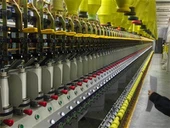
Twisting machines, as a key piece of textile machinery, are primarily used to twist multiple single yarns or threads into strands with a certain strength, elasticity, and aesthetic quality. Twisting machines can be categorized into various types based on different process requirements, structural characteristics, and application scenarios. This article systematically explains the main types of twisting machines from the perspectives of drive method, spindle structure, application, and degree of automation.
Classification by Drive Method
The drive method of a twisting machine directly affects its operating efficiency and scope of application. It is primarily categorized into mechanical and electronic drives.
1. Mechanically Driven Twisting Machines
Mechanically driven twisting machines rely on traditional mechanical transmission methods such as belts and gears for power transmission. They have a relatively simple structure and low cost, making them suitable for medium- and low-speed production. This type of equipment is commonly found in small and medium-sized textile enterprises, and still has some application in traditional textile processes where automation is not a high requirement.
2. Electronically Driven Twisting Machines
Electronic-driven twisting machines utilize servo motors or variable frequency motors for precise control of speed and twist, offering greater flexibility and production efficiency. This type of equipment is typically equipped with a digital control system and is suitable for high-speed, high-precision twisting processes, making it widely used in modern textile production lines.
Classification by Spindle Structure
The spindle is the core component of the twisting machine, and its structure directly affects the uniformity and stability of the twist. Based on the arrangement and movement of the spindles, twisting machines can be divided into ring twisters, two-for-one twisters, and free-spindle twisters.
1. Ring Twister
Ring twisters use a ring structure, where the yarn rotates around the spindle during the twisting process, resulting in uniform twist and suitable for producing high-quality yarn. This type of equipment is widely used in industries such as cotton and wool spinning, especially where high yarn strength is required.
2. Two-for-One Twister
Two-for-One Twisters use a dual-roller or multi-roller structure, allowing the yarn to be twisted and combined simultaneously, thereby improving production efficiency. They feature higher twist and are suitable for processing specialty yarns such as chemical fiber filament and core-spun yarn.
3. Spindle Twister
The spindles of a spindle twister move along a track and are suitable for twisting coarse yarn or special fibers. Historically, this type of equipment was widely used, but due to its low level of automation, it has been gradually replaced by more advanced models in the modern textile industry.
Classification by Application
Depending on the fiber being processed, twisters can be divided into cotton twisters, wool twisters, chemical fiber twisters, and blended twisters.
1. Cotton Twister
Designed specifically for cotton fibers, this twister is suitable for twisting carded or combed cotton yarn, emphasizing yarn softness and uniformity.
2. Wool Twister
Designed for animal fibers such as wool and cashmere, its structure emphasizes anti-static properties and minimizes fiber damage, making it suitable for the production of high-end wool products.
3. Chemical Fiber Twister
Suitable for twisting chemical fibers such as polyester and nylon. It typically features higher speeds and enhanced wear resistance to meet the high strength requirements of chemical fiber yarns.
4. Blended Twisting Machines
These machines can simultaneously process multiple fiber blends, such as cotton/polyester and wool/acrylic, making them suitable for the production of multifunctional textile products.
Classification by Degree of Automation
With the development of intelligent manufacturing technology, the automation level of twisting machines is continuously improving. They are mainly categorized into manual/semi-automatic twisting machines and fully automatic twisting machines.
1. Manual/Semi-Automatic Twisting Machines
These machines rely on manual operation or partial automation, making them suitable for small-batch, high-variety production. They offer high flexibility but low efficiency.
2. Fully Automatic Twisting Machines
These machines utilize computer control, enabling automatic bobbin changing, twist adjustment, and fault detection, significantly improving production efficiency and product quality. They are the mainstream choice in the modern textile industry.
Twisting machines are categorized in various ways, with different types suited to different production processes and fiber materials. With advancements in textile technology, twisting machines are moving towards higher speed, intelligent operation, and multifunctionality. Textile companies should select the appropriate twisting machine type based on their production needs to improve production efficiency and product quality.